

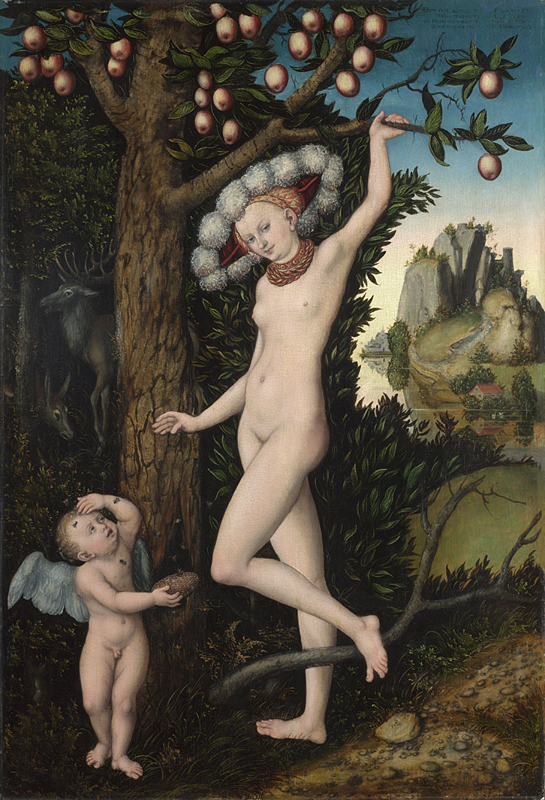
Cupid complains to Venus of being stung by bees when stealing a honeycomb. This is to be taken as a moral commentary; as the abbreviated Latin inscription observes: life’s ‘pleasure’ is mixed with ‘pain’.
The inscription translates as: ‘Young Cupid was stealing honey from a hive when a bee stung the thief on the finger. So it is for us: the brief and fleeting pleasure we seek/ is mingled with sadness and brings us pain’.
The subject derives (but the last two lines of the inscription do not) from the Greek poet Theocritus’ ‘Idyll’ 19, ‘The Honeycomb Stealer’. The work of Theocritus was published in the original Greek by Aldus Manutius in Venice in 1495/6, and it is possible that Cranach may have had access to this edition through his employers, the Electors of Saxony. Melanchthon, a humanist of Wittenberg, the principal seat of the Electors of Saxony, appears to have been responsible for initiating several textual variants of the subject in Latin during the 1520s.
Melanchthon also spearheaded visual responses to the subject: the inscription on this painting has been taken from an epigram by the young humanist Georg Sabinus, who was in the circle of (and became the son-in-law of) Melanchthon.
Evidence survives that Cranach’s composition was known by these scholars: another member of Melanchthon’s circle, Eoban Hess, wrote ‘Tabella Luce’ (‘the painting by Lucas’) in his copy of the poem, perhaps referring to the composition by Lucas Cranach, the Elder (1526-7).

 Amor Vincit Omnia